
Tech Corner June 15, 2026
Extraction Makes Data Usable, but Agents Make It Answerable


Early in my career, I worked on a credit risk team at a major investment bank. We manually entered financials into several models and systems, complemented it with qualitative data from corporate filings and ratings agencies, and drafted detailed credit reviews by hand. I learned to love pivot tables and bullet points. The work was important, but the manual data handling challenged our ability to provide both ad hoc, deal-driven reviews and our regular counterparty monitoring.
I see the same dynamic play out today across many institutional allocators. Teams responsible for portfolio monitoring, risk assessment, and investment reporting manage a steady stream of unstructured documents: capital account statements, capital notices, financial statements, schedules of investments, and more.
The industry has largely solved the problem of collecting and storing these documents. The harder challenge is turning them into answers. When an investment professional asks, "Which managers have exposure to this sector?" or "What changed in this quarter's reporting?" the information exists, but extracting, validating, and connecting it across thousands of documents still requires significant manual effort.
All institutions have portfolio management systems (often multiple!) that serve as the system of record for this data. While essential, these platforms sit at the end of a long data pipeline. Documents arrive, are manually extracted and normalized, pass through a reconciliation workflow, and eventually land in the system. That process can take days, but in the meantime, questions are piling up: Portfolio Management needs to generate an exposure summary for an IC meeting, Risk needs to cross-check concentration after a new commitment, Accounting is looking for more details on a capital call. Each of these is less a data retrieval problem than a reasoning task, the kind of work that has historically required an analyst to assemble from multiple sources.
These questions arise constantly. In my experience, it’s always when volumes are high and the key team members are out of the office, and the answers are locked inside documents that aren’t fully processed yet.
Getting documents into a system is a solved problem. Turning them into answers that anyone can act on is where the real opportunity remains.
The Foundation: Making the Data Usable
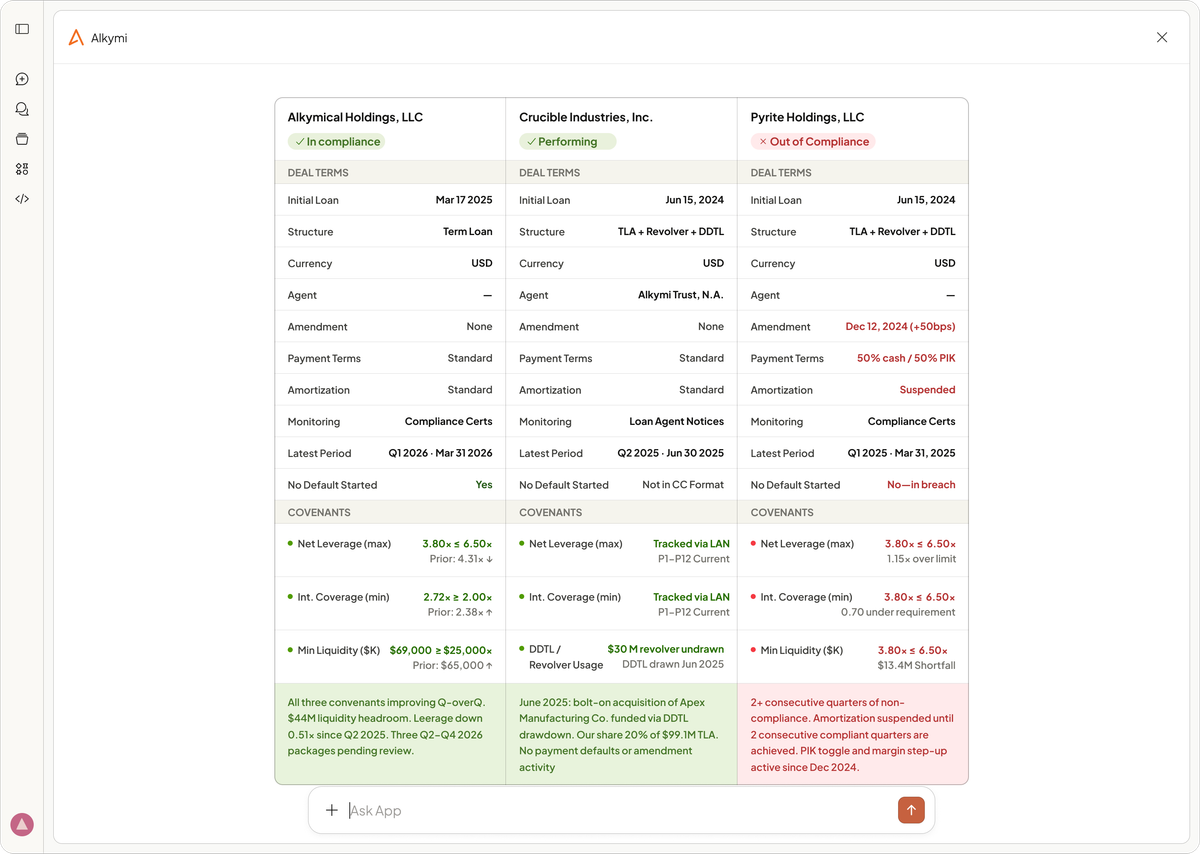
Alkymi's extraction workflows are purpose-built for alternative markets documents. For teams focused on fund investments, our Alkymi Alts Bundle – capital account statements, capital notices, and schedules of investments – is the go-to, while credit-oriented teams leverage our Alkymi Private Credit Bundle - financial statements and compliance certificates workflows, and loan ops leverage our loan agent notices pattern.
Each pattern workflow normalizes the extracted data into a consistent, validated structure regardless of GP, administrator, loan agent, or software platform that produced the original document. This matters because the quality of any downstream analysis depends entirely on the quality of the data underneath it: garbage in, garbage out. Here, Alkymi handles this foundational work so that the analysis can be trusted by your team.
The Agent Layer: Making It Answerable
Alkymi's workflows can now be paired with tailored analytical skills and knowledge bases, connected via Model Context Protocol (MCP), that transform extracted data into structured, repeatable analysis. We meet teams on the platforms where they work, whether Anthropic’s Claude, OpenAI’s ChatGPT Enterprise, Google’s Gemini, and Microsoft’s Copilot Studio. Each skill defines an analytical methodology, but the underlying LLM applies reasoning to each document it encounters, adapting to the nuances of the data received, selecting the appropriate analytical approach for each user request, and flagging where the data departs from expected patterns.
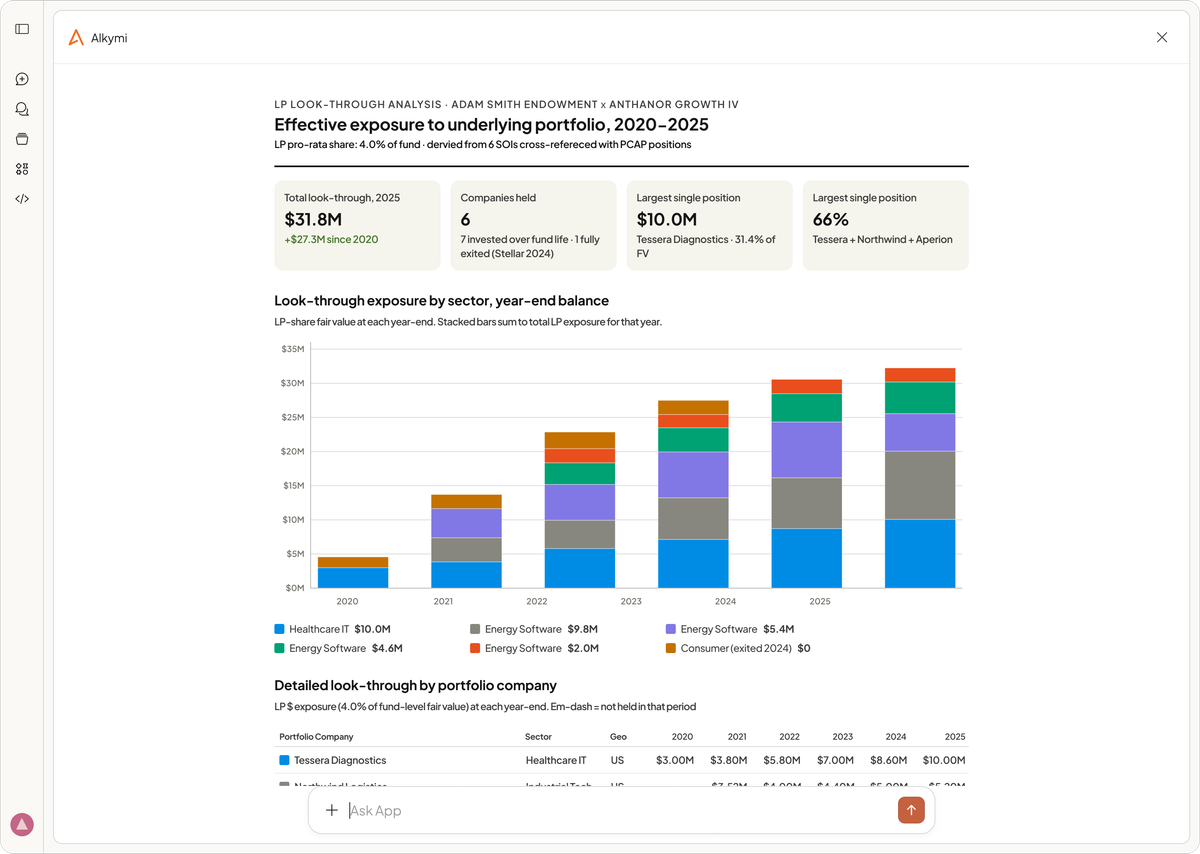
The Alternatives Bundle, for example, includes skills for portfolio exposure analysis, fund performance attribution, capital activity review, and report generation. Each skill defines how the LLM should apply reasoning to accomplish a given task in a consistent manner. For example the portfolio exposure skill:
Reconciles holdings across multiple managers' funds into a unified view
Identifies where the same underlying companies appear across funds
Evaluates concentration across sector, geography, and vintage year
Assesses concentration risks against the team's defined thresholds and escalates flags where warranted
Assembles a set of tables and written observations, based on fully configurable templates
In practice, teams don't select skills from a menu or navigate a set of predefined reports. They ask questions in natural language, and the LLM determines which skills to invoke, which data to pull, and how to structure the response. A single query might draw on one skill or several, depending on what the question requires. The skills define the analytical methodology while the LLM handles the reasoning about when and how to apply it.
These skills can also be enriched with data from additional patterns to reflect the full nature of a team's workflows. Skills and templates are fully customizable at the client level, so a risk team's analytical workflow can look quite different from an accounting team's, even when both draw on the same underlying data. Financial statement data, for instance, can layer borrower-level metrics like leverage or liquidity ratios on top of a compliance certificate workflow, giving teams a fuller picture.
These are not one-off queries. Each skill triggers a defined, consistent output that is trustworthy enough to share with colleagues and put in front of an investment committee.
What This Looks Like in Practice
To show how this comes together end-to-end, consider a pension fund that allocates across 50+ private equity, real estate, and credit funds. A new set of quarterly documents have been issued by the GPs, and deadlines are pending.
With Alkymi, the documents are first sourced from GP portals via our Portal Download Service, then extracted and normalized as they arrive. After a quick human-in-the-loop review by the operations team, the data is ready for analysis. From here, each team simply asks the questions relevant to their function. The accounting team asks about net cash flows and near-term liquidity, and the agent routes to the capital activity skill. Risk managers ask where concentrations in the underlying portfolio are approaching internal limits, triggering the portfolio exposure skill. Investment staff request the latest fund-level returns ahead of a manager's pitch, and the agent pulls from performance attribution. Each team is working from the same validated data, but the analytical lens, output format, and flagging logic reflect their specific workflows and priorities.
Each of these analyses can produce a structured set of outputs that can be reviewed in Claude or Copilot, or exported as a Word document, PowerPoint deck, or Excel file.
Getting Closer to the Data
Alkymi's extracted data flows into portfolio monitoring systems, IBOR/ABOR, and other systems of record as part of the standard pipeline. The skill layer adds something those systems were never designed to provide: a flexible, close-to-the-data source of ad hoc analysis, available as soon as documents are processed, producing consistent outputs that teams can act on between reporting cycles.
For teams managing large, complex portfolios across dozens of GP relationships, this means faster answers paired with consistent methodology. The analysis that used to require hours of manual assembly can be produced on demand, with the same structure and rigor every time. It would have saved me days each month on my old credit risk desk, and I suspect it would do the same for your portfolio management, risk, operations, and accounting teams doing similar work today.
Connect with us to see how this works with your investment documents and analytical workflows.
Nate Byerly is a Senior Solutions Architect at Alkymi, where he works with financial institutions on document extraction and analysis workflows, with a particular focus on credit. Before joining Alkymi, Nate spent five years at Addepar in senior implementation roles, including leading the firm's expansion into Canada. He started his career at Goldman Sachs and holds undergraduate and graduate degrees from Columbia University.
More from the blog
Private Credit: The Reckoning Is Here, And the Regulators Have Arrived
by John Park, Director of Professional ServicesThe private credit market is maturing. Discover how growing regulatory expectations are reshaping operations, risk management, and reporting.

Global Fortune 500 Asset Manager Selects Alkymi for Private Credit Operations
by Harald Collet, CEOSelected by a leading added allocator to automate private credit operations and transform unstructured documents into workflow-ready investment data..

Alkymi's CEO Recognized Among Top Innovators in Private Wealth Infrastructure
by Maria Orlova, Head of MarketingThe 2026 Who's Who in Private Wealth Infrastructure recognizes Alkymi CEO Harald Collet for driving innovation across private wealth and alternatives operations